The Amatola Trail

Do you want to add South Africa’s toughest hiking trail to your checklist? If so, the Amatola Trail will live up to that challenge while spoiling you with the experience of a lifetime (and you’ll know that you’ve conquered this beast)!
The multi-day hutted hike covers about 100 km over six days in the Eastern Cape, starting close to King William’s Town, traversing the Hogsback Mountains, and finally reaching the Hogsback village. Hikers can look forward to encountering various mountain pools and waterfalls along the route and hiking through an indigenous rainforest throughout more than half the route.
This trail doesn’t offer a slackpacking option, which is why The Trail Food Co. is here to make your backpack as light (and packed with delicious meals and snacks) as possible. Our hiking meals and hiking snacks are ideal for multi-day hikes, or you could consider ticking off your meal planning by selecting your favourites and getting one of our lightweight, healthy, and convenient multi-day packs.
Here’s all the info you need to prepare for the Amatola hiking trail!


The Ultimate Guide to Hiking the Amatola Trail
WHY SHOULD YOU CHOOSE TO HIKE THE AMATOLA?
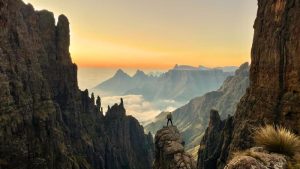
This trail is one for the bucket list because of the diversity it offers. You’ll get to experience mountains, forests, waterfalls, and scenic flora that make it one of the most unique trails in South Africa. If you’re an experienced hiker, it’s simply a hike that has to be on your list.
It is a physically challenging trail, so it’s not for novice hikers, and the fact that it traverses mountain terrain means that the weather can change at a whim. Be prepared for hot and humid weather that can change to freezing temperatures, rain, or even snow. The Amatola trail is rated as one of the top forest-clad mountain hiking routes in South Africa, with unforgettable views, promising a challenging yet rewarding hiking adventure.
THINGS TO LOOK OUT FOR ON THE AMATOLA
Besides the breathtaking landscapes, hikers should keep an eye out for the following highlights on the Amatola:
- Scenic waterfalls
- Epic mountain views
- Knysna Turacos
- Natural pools for a swim

WHEN TO HIKE THE AMATOLA
The best time to hike the Amatola trail is during autumn and spring, as the weather is best during these seasons without extreme fluctuations.
May is generally the best month to go on this trail, although you should be aware of snow that could arrive early.
The summer months can be a mix of exceptionally hot and humid conditions or cold and wet weather. The trail closes during the winter months of June, July, and August due to the likelihood of snow falling and the days being shorter.
ABOUT THE AMATOLA TRAIL
Here’s all the essential information you need to know about the Amatola hike.
The full hike is approximately 105 km long and takes 5 nights and 6 days to complete.
Hikers start the route at Maden Dam, located close to King William’s Town, and end the hike in the Hogsback village.
100km – 105km
The Amatola rates at a 9-10/10.
The hike is extremely challenging due to long days and big ascents and descents that require probably more than adequate fitness levels.
Hikers need to be fit and strong – this hike is not for beginner hikers. There are also some minor river crossings on the route.
The minimum age to go on this route is 15.
This is a self-carry hike, but “goodie drops” are available at an additional cost (doesn’t that term sound yummy?!).
Although there is no slackpacking or porterage, Amatola Trails can drop any supplies for hikers at the overnight huts. If you have any frozen or room-temperature “goodies” that you’d like the organisers to keep cold or store, they will do so and drop them off for you at your overnight hut in the pre-packed plastic boxes.
These goodie drops typically happen before hikers arrive at the huts, so don’t bargain on being able to send anything back with the organisers. Hikers can also look forward to the end of Day 5 when Amatola Trails can supply warm pizza and cold beer or cold drinks from the nearby “Away with the Fairies” Nature Lodge. The pricing for the goodie drops varies since it depends on the time required and the difficulty for their 4x4s to reach each hut. Note that prices are charged per goodie drop and not per person.
Here are the most recent prices per goodie drop to each hut:
Hut 1 – Gwili Gwili: R2000
Hut 2 – Dontsa: R1500
Hut 3 – Cata: R2500
Hut 4 – Mnyameni: R2000
Hut 5 – Zingcuka: R500 (for this drop, you will need to walk 300m to meet them at the road and carry your supplies back to the hut on your own).
The organisers also take the opportunity to service the overnight huts when they do goodie drops. They will check that the hut is clean and has enough firewood, which is also what the goodie drop pricing contributes to. They will deliver anything that is sold at Away with the Fairies but, unfortunately, can’t do any supermarket shopping on your behalf.
Also, please take note that you must burn your paper and cardboard waste and carry the rest out from the huts.
All the huts are very basic, with bunks and mattresses. The huts each have an axe, braai facilities, firewood, and either a long drop or flushing toilets.
Each hut also has a Trellidor safety gate that hikers can lock at night.
- How does one get water along the route?
Hikers can find water most of the way along the trail. Only day 2 is typically of concern, and you’ll need to fill up with about two to three litres at the first stream for the day.
- Do you need to take water purifying drops or a water purifier?
The water is safe for consumption all along the trail. There are no villages above the trail, so you don’t have to treat the water. However, if you have any doubts about what might be further upstream, you could use purifying drops or a purifier. The water can get very muddy after heavy rains, so it’s best to bring a purifier or filter the water through your clothes if heavy rains are forecast.
Most of the huts have hot water with the help of donkey boilers which you’ll have to light. The task can be rather tedious when you’re caught in wet conditions, as you’ll have to cut kindling wood and build a fire to get the hot water going.
A minimum of 4 hikers and a maximum of 20 hikers are allowed.
Amatola Trails give each group a pre-hike briefing with all the information you’ll need to know about the trail and the trail points. If you are unsure about anything while on the trail, you can give them a call, and they will see how they can help. This service is included in every booking made through Amatola Trails.


THE AMATOLA ROUTE
Now that you have the basics about the trail, let’s take a look at the actual trail route and what you can expect on this marvellous hike!
Day 1 - Maden Dam to the Gwili Gwili Hut: 11.9km (763m Ascent)
Your first day on the trail will be the shortest, making it the only day where you don’t need to set off at sunrise. The Amatola Trails/Away with the Fairies Lodge and Backpackers in Hogsback will take hikers to Maden Dam from Hogsback. You can expect a 750m vertical ascent climb through the indigenous Pirie forest, which will make it feel as if you are travelling to another world.
A fun “fact” about this section of the hike is that it might look as if there are fresh dog faeces all around this area after heavy rains. It is, however, only digested soil that’s been left by the African Giant Earthworm, Microchaetus rappi. They can typically measure up to 1.8m in length – although the longest one (earning a Guinness World Record, at that) measured 6.7m when it was discovered on a road in King William’s Town in 1967. So, don’t worry about the “faeces,” it’s likely only the giant earthworms (that are so freakishly long that it should be okay to feel a bit uneasy about bumping into one!).
As the day nears its end, you will see the Gwili Gwili Hut on the side of a hill, where you will be spoiled with gorgeous views and can look forward to a hot shower and enjoying the braai area.
Day 2 - Gwili Gwili Hut to the Dontsa Hut: 19.14km (633m Ascent)
Although day 2 might look relatively easy on a map, don’t be fooled. This day is a tough section of the hike, and is characterised by undulations that can be tough on your knees through the indigenous forest, with very little natural sunlight.
You can fill up with water at the stream that’s about 1.2km into the route, and take about 2-3 litres to last you the entire day.
Although this day is an exhausting one, you will spend a full day in the forest, and your senses will be captivated all along the way. You’ll notice that the Dontsa Hut is more basic than the others, but it is right next to a stream and is still cosy and has a braai and a beautiful waterfall nearby.
Day 3 - Dontsa Hut to the Cata Hut: 20.62km (1024m Ascent)
You’ll have to hit the trail early on day 3, as it is the toughest and longest day on the route. Hikers will walk beyond the forest on this day and ascend to the plateau into macchia grassland with an abundance of wildflowers.
If you are hiking after recent rains, take care near the rocks at the waterfall about 4km into the hike, as they might be slippery.
You’ll most likely have heard that the final ascent to the Cata Hut is brutal yet breathtaking. Hikers will first walk through the Hovald Forest before descending past the Cata Forest Station and then take on the 5 km-long vertical ascent of 550m to reach the Cata Hut. This section will have a sting that you’ll remember, but you’ll also get treated with an incredible display of waterfalls in what is known as the Waterfall Forest along the way.
Day 4 - Cata Hut to the Mnyameni Hut: 14.56km (634m Ascent)
This day will have a more relaxed atmosphere to it, with rock pools to swim in along the way – and it is the second shortest day on the trail.
Hikers start by taking on a 600m ascent that will take you to the highest point on the trail, known as the Mighty Geju Peak (at an altitude of 1880m). If the trail happens to be misty, you can take an alternative route, but the views are astounding from the peak and worth the bit of extra work.
You’ll then walk across a meteorite crash site before beginning a steep descent into the Malan Forest into the Mnyameni Gorge. The Mnyameni Hut is the most remote of all the huts, and it may happen that it doesn’t have running water upon your arrival. If this is the case, there is a stream with water that’s safe for consumption located 10m from the hut.
Day 5 - Mnyameni Hut to the Zingcuka Hut: 19.42 km (991m Ascent)
Many hikers regard this day as their favourite, although it’s also a physically challenging day. Be sure to head out early since this leg is long, but also because there are several swimming spots to enjoy along the way.
You’ll hike along an open landscape for the majority of the day until the last few kilometres, where you’ll walk through the Schwarzwald Forest.
When you reach the inviting Zingcuka Hut, you can look forward to comfortable beds, and warm water (with the help of a donkey boiler) and admire the stars while you sit around a campfire on your last night of the trail.
Day 6 - Zingcuka Hut to the Tyume River: 16.2 km (855m Ascent)
Get ready for another day of stunning waterfalls located in the Schwarzwald Forest! You’ll have to focus on these views as you get ready to ascend a steep 800m to the main Hogsback Peak (at an altitude of 1845m). You will then descend into the Tyume River basin, which will lead you towards the end of the trail.
You can decide to walk the 4km that will take you to Hogsback and Away with the Fairies, or you can take the Amatola+. This route goes through the Auckland Nature Reserve and past the Madonna and Child Waterfall, as well as The Big Tree.
You’ll finish at the Away with the Fairies viewpoint and get to see the landscape you’ve traversed over the six days on trail.
A Shorter Alternative: The Zingcuka Route (2 Days)
If you’re in the mood for a shorter trail, the 2-day Zingcuka Loop starts where day 6 of the Amatola Trail ends in Hogsback, about 4 km from Away with the Fairies. You can hire a shuttle to the start of the trail, costing R50 per person. The Amatola Trails vehicles will leave at 06:00, and the shuttle service is free if you book a package.
If you book a package through Amatola Trails, they will offer free and safe parking for your vehicles at Acorn House during your hike. If you don’t book through Amatola Trails, there will be a charge of R100 per vehicle.

CURRENT COST TO HIKE THE AMATOLA TRAIL (2025)
The current cost for the Almighty Amatola 6-day hike is R3000 per adult hiker per day, and R2000 per schoolchild hiker per day.
This is a great deal as pretty much everything (except your hiking food which is where we come in) is taken care of for you!
This cost includes
- The 6-day and 5-night Hiking Permit
- Booking of the overnight huts
- Pre and Post hike dorm accommodation in Hogsback
- Shuttle service to the start of the trail (2-hour drive)
- Safe parking for your vehicle
- Hikers’ assistance
The 2-day Zingcuka Loop costs R1200 per adult and R1000 per school child and includes
- The correct Hiking Permit
- Booking of the overnight hut
- Pre and Post hike dorm accommodation in Hogsback
- Shuttle service to the start of the trail (a short 4km drive)
- Safe parking for your vehicle
- Hikers’ assistance
There are three payments involved in 2 stages.
- A non-refundable deposit to Away with the Fairies to confirm your reservation at the time of booking
- One month before your hike you pay the remainder owing to Away with the Fairies AND you make a direct payment to DFFE for the hiking permits which have been secured for you.
Please note that scholars have to provide a copy of their student cards before paying for the trail to get the student discount.
HOW TO BOOK TO HIKE THE AMATOLA
The booking of the Amatola Trail has been streamlined and simplified into a 3 step process.
Amatola Trails
- Fill out the online booking form on their website, which is a clear and easy online booking system.
- Enter the details of the main contact person booking and the number of adults and children hiking (Children should be a minimum of 15 years as this is a tough hike)
- You’ll be able to add extras here, such as additional or different accommodation*, airport transfers, Emergency Extraction Insurance, and goodie drops.
*Fairies Dorm is the included pre and post-hike accommodation. If you select Striders for example, then this is an upgrade to the included accommodation and will cost extra.
If you require accommodation for more than just the day before and the day after then you will need to contact Away With The Fairies directly.
As mentioned above, a 25% non-refundable deposit is required upon booking.
If you’ve made a full payment, 75% of the balance is refundable if you cancel 30 days or more before the trail starts.
Cancellations made less than 30 days before the start of the trail will result in losing your payment. However, bookings can be postponed and hikers can be transferred to other groups.
Department of Agriculture, Forestry & Fisheries
Tel: +27 (0)43 642 2571
Email: Amatolhk@daff.gov.za
Away with the Fairies
Tel: +27 (0)45 962 1031
Email: hogsback1@gmail.com

GETTING TO THE AMATOLA
Here’s all the information you will need to get to the Amatola Trail.
Where to stay before and after the Amatola hike?
Since Hogsback is the closest town to the trail, most people opt to stay there before and after the Amatola hike. Away with the Fairies is a popular hostel for most hikers, as it is comfortable and has friendly staff. Those driving from Cape Town can also consider extending their trip if they feel like exploring the Garden Route.
Airport Shuttle
Amatola Trails run shuttle services between Hogsback and East London and the airport. The shuttle has a one-way cost of R1500 for groups between 1-5 people or R2400 for groups that consist of 6-15 people.
How To Reach the Starting Point for the Amatola
Due to safety precautions, it’s not advisable to leave your vehicle at Maden Dam while you’re on the Amatola Trail. Hikers are urged to make use of the Amatola Trails’ shuttle service from Hogsback to the starting point of the trail, which is priced at R300 per person for a minimum of 4 people. Your departure time will get confirmed during your pre-hike briefing.
If you have booked a package through Amatola Trails, you’ll receive complimentary parking at Acorn House. Hikers who haven’t booked through Amatola Trails can leave their vehicles at Acorn House at a cost of R100 per vehicle.
WHAT TO PACK FOR THE AMATOLA TRAIL
Are you wondering what you should pack for the Amatola Trail? Take a look at our article on what to pack for a multi-day hike for some pointers on the necessities!
HOW TO PACK FOR THE AMATOLA TRAIL
We know it can feel daunting when you need to establish how best to pack your backpack for a multi-day hike. Here are our top tips on how to pack your backpack to ensure a comfortable trail.
TOP TIP
Make sure you pack some lightweight firelighters to help you get the donkey boiler started at each hut.
You will thank your lucky stars once you’re luxuriating under a hot shower – particularly if it’s been a cold, wet day!
DON'T FORGET TO
Interestingly, Amatola (also known as amatole or amathole) translates to “calves” in Xhosa due to the mountain range resembling a herd of calves. The densely forested mountains have a deep spiritual meaning for many of those still living in this beautiful area, making the hiking experience even more special.
Keep in mind that the Department of Forestry faces challenges in getting to the remote huts to empty the rubbish bins, so remember that you’ll have to carry out any trash from your huts and burn any paper or cardboard waste.
Try to set out on the trail by 06:00 at the latest to make the most of your hiking experience. You should also be prepared to hike for about 10 hours per day on the trail. The Amatola is physically demanding, and if you’ve ever done the Fish River Canyon Trail, the Amatola is tougher due to its major ascents and descents.
If you can, it’s best to get a larger group of hikers together of at least four to five people. There have, unfortunately, been past incidents of crimes at some of the huts, so it’s best to have safety in numbers.
Finally, leave a set of clean clothes in your car before you set out on the trail.
FAQs
Here are some of the most frequently asked questions about the Amatola.
There are extraction services for non-life-threatening situations. Due to the remoteness of the huts and the bad conditions of the roads in bad weather, some of the overnight huts may not be accessible by car. There is a rate of R1500 for the first 4 hours of an extraction and R500 for each hour after that.
Should you require an extraction from Zingcuka, there is a charge of R500, although it will mean that you haven’t completed the Amatola Trail. The organisers will contact Emergency Medical Services for all life-threatening situations, which doesn’t constitute an extraction fee that will be due to the organisers.
It depends on the size of your group. If you are a larger group, there is less of a chance that other hikers will be with you. However, smaller group bookings might mean that groups will share the huts and the trail, more specifically during peak hiking seasons.
FINAL THOUGHTS
If you have a keen sense of exploring and thrive on embarking on challenging hikes, the Amatola is definitely the hike for you. You’ll be immersed in breathtaking natural landscapes and experience a sense of remoteness with every step you take on this trail.
If you’re wondering what to pack for your meals on the Amatola, look no further than our multi-day hiking meal packs. We deliver across the country, so all you have to do is check out all our yummy hiking meals and hiking snacks, order, and get ready for your adventure!

The Trail Food Co would like to thank Dave Pahl from Creating Dust for his help on this Ultimate Guide to The Amatola Trail.
If you have an epic hike or trail to share, or if there are any corrections or updates that you would like to suggest to this trail guide, please email

FUEL FOR YOUR ADVENTURES
I'm ready to hike
All our hiking meals are healthy, lightweight, and convenient.
We’ve done all the planning so that you can simply hike!
Ultimate Hiking Guides




Adventure Insights


Featured Products
-
 Main Meals
North African Couscous with Lamb
R75.00 – R170.00Price range: R75.00 through R170.00 Select options This product has multiple variants. The options may be chosen on the product pageRated 0 out of 5 -
 Main Meals
Hiker’s Bobotie
R75.00 – R165.00Price range: R75.00 through R165.00 Select options This product has multiple variants. The options may be chosen on the product pageRated 0 out of 5 -

-