The Hluhluwe-Imfolozi Primitive Trail

We had just finished supper and were sitting around the fire discussing the night’s watch schedule when we heard it.
A leopard.
Not the distant rasp of a leopard somewhere across the valley. Not a vague sound that might have been a leopard.
This was close.
Very close.
The male’s rasping call echoed across the river and every head around the fire snapped up at once. One of the hikers grabbed a spotlight and binoculars and soon picked up movement on the opposite bank. There they were: a male and female leopard drinking in the darkness less than a hundred metres away.
Nobody slept quite as soundly after that.
Welcome to the Hluhluwe-iMfolozi Primitive Trail.
Not only one of South Africa’s greatest wilderness experiences, but the place where the concept of the wilderness trail was born.
This is not a hiking trail in the traditional sense. You won’t spend your days chasing mountain passes, ticking off summits or trying to beat a personal best time.
Instead, you’ll spend five unforgettable days walking through Big Five country with nothing between you and the wildlife except two highly experienced guides, sleeping under the stars, cooking over open fires and experiencing one of South Africa’s last truly wild places on foot.
After completing the four-night Primitive Trail in June 2026, I can honestly say it was one of the most exciting wilderness experiences I have ever had.
The Ultimate Guide to The Hluhluwe-iMfolozi Primitive Trail
Why Should You Choose the Hluhluwe-iMfolozi Primitive Trail?
The Primitive Trail offers something increasingly rare in modern life: genuine wilderness.
There are no fences.
No vehicles once you are out on trail.
No lodges.
No generators.
No Wi-Fi.
No ablution blocks.
No neat little campsite signs telling you where to pitch your tent.
For five days you live as simply as possible while exploring one of Africa’s oldest conservation areas on foot.
What makes the experience exceptional is not the distance covered, but the quality of the wildlife encounters. During our trail we saw elephant, buffalo, rhino and leopard on foot, along with plenty of general game, birds and smaller creatures. We heard lions regularly, listened to hyenas calling at night and saw fresh wild dog tracks in the sand.
Even more surprising was how safe I felt throughout the experience. There were certainly moments when the adrenaline was flowing, but I never felt unsafe. The professionalism and experience of the guides inspired confidence from the very first day.
A Trail With Conservation History
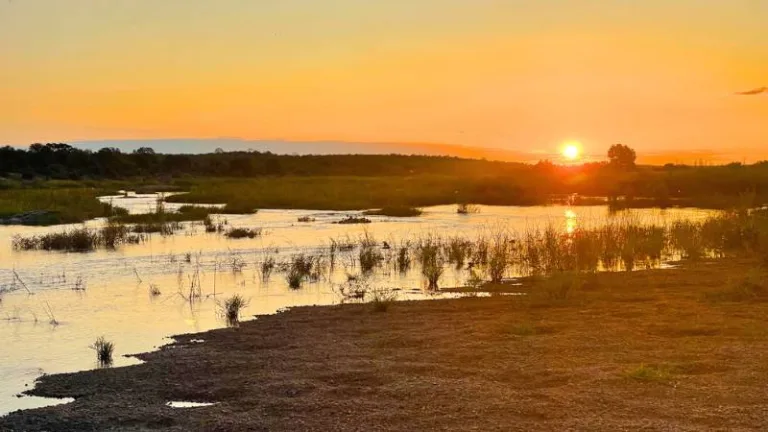
The Hluhluwe-iMfolozi Wilderness Area is more than just another hiking destination.
Widely regarded as Africa’s oldest proclaimed game reserve, the park has been protecting wildlife since 1895 and played a pivotal role in saving the southern white rhino from extinction.
It is also the birthplace of the modern wilderness trail.
In the 1950s and 1960s, conservation pioneer Dr Ian Player and his legendary Zulu tracker and mentor, Magqubu Ntombela, helped develop the concept of guided wilderness trails through the iMfolozi wilderness area. Their vision was revolutionary for the time: instead of viewing wildlife only from vehicles, people would experience the bush on foot, moving slowly, observing carefully and reconnecting with nature.
Today, wilderness trails around the world owe something to the ideas that were first developed here.
Even the park’s name tells part of its story.
Older hikers may remember it as Hluhluwe-Umfolozi Park. The name was later changed to Hluhluwe-iMfolozi after it became recognised that the area contains two major rivers: the Black Umfolozi and the White Umfolozi. Umfolozi refers to a single river, while iMfolozi reflects the plural.
As you walk through this wilderness, it is worth remembering that you are not only following animal paths. You are also walking through one of the most important landscapes in African conservation history.
Great For
The Primitive Trail is ideal for:
- Wildlife lovers
- Birders
- Keen hikers
- Photographers
- People who enjoy true wilderness experiences
- Adventurers who don’t need luxury
- Anyone wanting to experience Big Five country on foot
- Hikers interested in conservation history
- People who enjoy learning about birds, trees, geology, culture and animal behaviour
Less Suitable For
This trail may not suit:
- People who dislike camping
- Anyone needing proper ablutions
- Hikers wanting fixed daily distances
- People who don’t enjoy carrying a heavy pack
- Anyone uncomfortable with the idea of sleeping unfenced in Big Five country
- Those who expect luxury safari comforts
Things To Look Out For On The Primitive Trails
The exact route varies depending on the guides, the group, wildlife movements and water availability. That is part of the magic.
This is not a neatly prescribed point-to-point hike where every group has exactly the same experience.
Things to look out for include:
- Elephant encounters on foot
- Buffalo herds
- Rhino
- Leopard tracks and, if lucky, leopard sightings
- Lion calls at night
- Hyena calls after dark
- Wild dog tracks
- Crocodiles along the river
- Excellent birdlife
- Butterflies
- Interesting trees
- River crossings
- Clifftop views
- Signs of animals in the sand
- The silence of the wilderness once the fire dies down
The wildlife viewing on foot was the best I have ever experienced.
When To Hike in Hluhluwe-iMfolozi
We hiked in mid June 2026 and found winter to be an excellent time for the trail.
March – May
The bush is arguably at its most beautiful.
- Green grass
- Healthy rivers
- Lush vegetation
- Good birding
- Comfortable nights (especially April and May)
- Less dusty than winter
The downside is that wildlife can sometimes be harder to spot because there is simply more vegetation and more water available.
June to August
- Cooler temperatures
- Very few mosquitoes
- Easier river crossings
- Comfortable sleeping conditions
- Excellent wildlife viewing around water sources
September to November
- Hotter conditions
- Excellent game viewing as water becomes scarcer
- Less pleasant for carrying heavy packs
December to February
- Generally not offered
- Hot, humid and wet
- Summer thunderstorms
- Rivers can become more challenging
- Increased insect activity
About the Hluhluwe-iMfolozi Primitive Trail
The four-night Primitive Trail starts at Mpila Camp in Hluhluwe-iMfolozi Park.
You arrive at Mpila, sign in and pay your park fees. You then meet your guide and either drive or are taken to Mdindini Trails Camp.
Mdindini is where the real sorting begins.
If you do not have your own hiking equipment, this is where Ezemvelo can issue kit. If you do have your own gear, you bring it here and then add the communal food and cooking equipment.
And this is where the trail immediately becomes different from most modern multi-day hikes.
Ezemvelo supplies all the food.
On the one hand, this is incredibly convenient. You do not have to plan menus, shop for ingredients, coordinate group meals or worry about whether everyone has enough food.
On the other hand, and it is a fairly big “other hand”, it means your backpack becomes pretty damn heavy.
Our group had six hikers plus two guides. Between us, we carried two large metal saucepans, a large kettle, frozen meat for eight people, mielie meal, rice, pasta, cans, coffee, hot chocolate, sugar and powdered milk.
Most hikers expect a normal backpacking experience.
What they do not expect is carrying food for eight people, two large cooking pots and a kettle through Big Five country.
When I asked our lead guide why hikers do not simply bring their own lightweight trail meals, he explained that the trail is built around the concept of ubuntu. Cooking together, sharing responsibilities and eating from the same pot is part of the wilderness experience.
I completely understood his point.
That said, after carrying all that food and washing communal pots, those of us who have used lightweight cook-in-bag hiking meals had a whole new appreciation for the difference in weight and convenience.
The food was good.
The challenge was not quality.
The challenge was weight.
5 days, 4 nights.
Although you are out for five days, it is not about covering large distances. The route can change depending on the group, guide decisions, water availability and animal movements.
On our trail, the days carrying full packs were not especially long. We had fairly leisurely mornings, walked for a while, stopped regularly and generally reached camp in the afternoon.
One day was a longer walk of around 10 km, but we did that with daypacks because we spent two nights at the same camp.
Given the weight of the communal food and equipment, I was extremely grateful for that.
Moderate.
Moderate to challenging if your pack is particularly heavy.
The walking itself is not especially technical or extreme. The biggest challenge is the weight of your pack and the fact that you are moving through wild, uneven terrain.
You need to be reasonably fit, comfortable carrying a backpack and able to walk in warm conditions over rough ground.
You do not need to be an elite athlete.
You do need:
- Reasonable hiking fitness
- The ability to carry a loaded backpack
- Good balance on uneven ground (I had ACL surgery in January and managed fine)
- Comfort with river crossings
- The ability to sleep outdoors
- A willingness to go without normal facilities for four nights
The guides may adjust the route depending on the group’s ability, which is another reason not to get too fixated on exact distances.
The minimum age is 14, provided the child is accompanied by a parent or guardian.
There is no specific maximum age, but older hikers may need medical clearance. If you are over 70, it would be sensible to check requirements when booking and be prepared to provide a doctor’s letter if requested.
This is a self-carry trail.
You carry your own sleeping gear, clothing, personal items, water and a share of the communal food and equipment.
If you have your own lightweight hiking gear, take it.
Ezemvelo can provide equipment for hikers who do not have their own, which makes this trail unusually accessible for people who want to experience a true wilderness trail without buying an entire hiking setup.
That is a huge plus.
However, if you already own a comfortable backpack, sleeping bag, sleeping mat and groundsheet, you will almost certainly prefer using your own gear.
Maximum group size: 8 people
Minimum group size: 4 people (individuals can book, but the hike will only go ahead if at least four participants are confirmed)
Accommodation is as primitive as the name suggests.
You sleep outside on the ground.
No tents.
No huts.
No platforms.
No ablutions.
No showers.
No formal campsites.
We slept on groundsheets under the stars. Where you sleep depends on the route chosen by the guides.
Our first night was at a spectacular clifftop site. Nights two and three were beside the river, reached by wading across and scrambling up onto rocks. The fourth night was at another campsite that felt more exposed, which made the leopard encounter even more memorable.
The Clifftop Camp
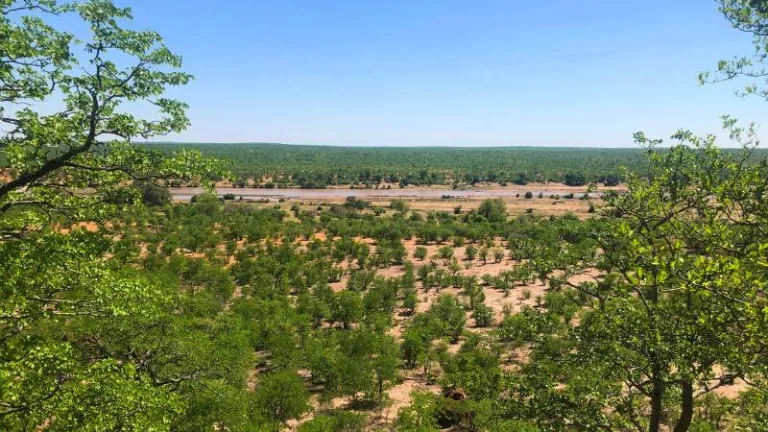
Our first camp overlooked the river from a spectacular clifftop position.
The views alone were worth the walk.
From camp we watched elephant, buffalo and a crocodile below us through binoculars, while the surrounding wilderness stretched into the distance.
During the night our guide spotted a leopard nearby while on watch duty.
Actually, “spotted” is perhaps understating things.
The guide came to wake us and there I was at one o’clock in the morning, stumbling around the bush in my sleeping socks trying to find a leopard.
I never did see the leopard.
I did, however, manage to step squarely into a fresh buffalo pat.
Some wilderness experiences are more glamorous than others.
The River Camp
Our second and third nights were spent beside the river.
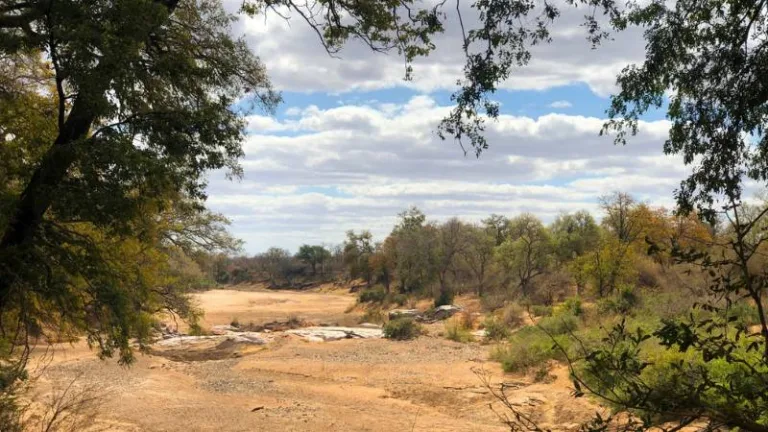
Reaching camp required wading across the river before scrambling up onto rocky ledges above the water. The river was easily crossable in June and not deep.
The camp felt wonderfully remote. We slept on rocks above the river, with a steep slope behind us, which made the site feel surprisingly safe.
At night we heard splashing in the river, distant calls and the small sounds of the bush settling into darkness.
The Final Camp
Our final camp felt more exposed than the others.
This is where we heard the leopard rasping after supper.
The male sounded incredibly close. One of the hikers grabbed a spotlight and binoculars and picked up the male and female leopard drinking on the opposite side of the river, perhaps 90 to 100 metres away.
After that, everyone took their night watch shift very seriously.
Funny, that.
Water is collected from rivers.
The guides drank the river water directly and were perfectly fine. Some hikers used purification drops. I used a water filter.
No one became ill.
That said, I would strongly recommend taking your own preferred water treatment method, whether that is a filter, purification drops or tablets.
If water had been boiled for tea or cooking, we used it that way too.
There are no facilities once you are out on trail.
Expect:
- No toilets
- No showers
- No taps
- No electricity
- No bins
- No formal campsites
- No tables
- No chairs
- No washing-up basins
- No privacy, except what the nearest bush can kindly provide
You bathe in the river where possible and go to the toilet in the bush.
Everything is kept as low-impact as possible.
This is a fully guided wilderness trail in Big Five country. Routes and distances vary, hikers carry their own gear plus communal supplies, sleep outdoors and take turns on night watch. Water comes from natural sources and there are no ablutions, so a water filter, headlamp and a willingness to embrace the wild are essential. Expect a few sandflies, the occasional tick and plenty of unforgettable memories.
You will be expected to do night watch. Please see the section below on specifics.
Night Watch on the Hluhluwe-iMfolozi Primitive Trail
Night watch is part of the experience.
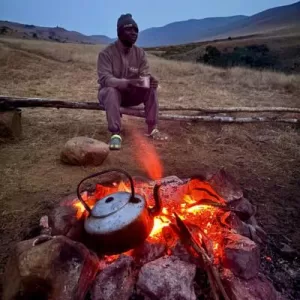
Everyone except the guides takes turns staying awake beside the fire and scanning for animals.
Because there were only six of us, each person had a 1.5-hour shift.
It is one thing to talk bravely about sleeping in Big Five country during the day.
It is quite another to sit alone by the fire in the early hours of the morning after hearing a leopard rasping nearby.
But that is exactly what makes the trail unforgettable.
Food on Trail
Ezemvelo supplies the food.
This is unusual compared with many modern multi-day hikes, where hikers bring their own meals.
The benefit is convenience. You arrive and the food is already sorted.
The downside is weight.
Our meals included:
- Chicken curry and rice
- Spaghetti bolognese
- Pap and beef stew
- A final-night pasta dish
- Muesli and rusks for breakfast
- Bread, processed cheese, tomato and cucumber for lunch
- Salami on some days
- Coffee and hot chocolate
The food was definitely not terrible. In fact, most of it was good.
The guides did an excellent job preparing meals, although I did feel a bit sorry for the backup guide who seemed to end up washing pots rather often.
If you are used to lightweight hiking meals, this trail will make you appreciate them deeply.
Not because the food is bad.
Because the pots are heavy.
And pots do not wash themselves, despite years of silent hoping.
The Hluhluwe-Imfolozi Guides
The guides are the heart of the experience.
There were two guides on our trail: a lead guide and a backup guide.
Both carried rifles and were armed throughout.
Our lead guide was excellent. He is also a BirdLife International bird guide and knew an enormous amount about birds, butterflies, trees, geology, local history, Zulu culture and the area’s natural environment.
The walks were not just about getting from one camp to the next. They were filled with bird calls, plant information, cultural stories, geology and history.
The guides gave the entire experience depth.
Without them, it would simply have been a walk through the bush.
With them, it became a wilderness education.
Wildlife Encounters on the Hluhluwe-Imfolozi Trails
The wildlife viewing on foot was exceptional.
During our trail we saw:
- Elephant
- Buffalo
- Rhino
- Leopard
- Crocodile
- General plains game
- Excellent birdlife
We also heard lions regularly and saw huge lion tracks in the sand.
We heard hyenas often at night.
We saw wild dog tracks.
We did not see hippo, and only saw one crocodile from a distance while up on the cliffs.
Our closest encounters were with elephant and buffalo.
Being on foot changes everything.
An elephant seen from a vehicle is exciting.
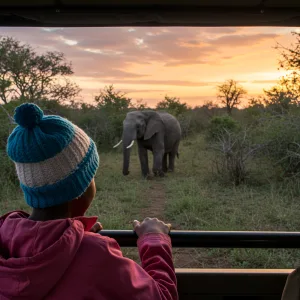
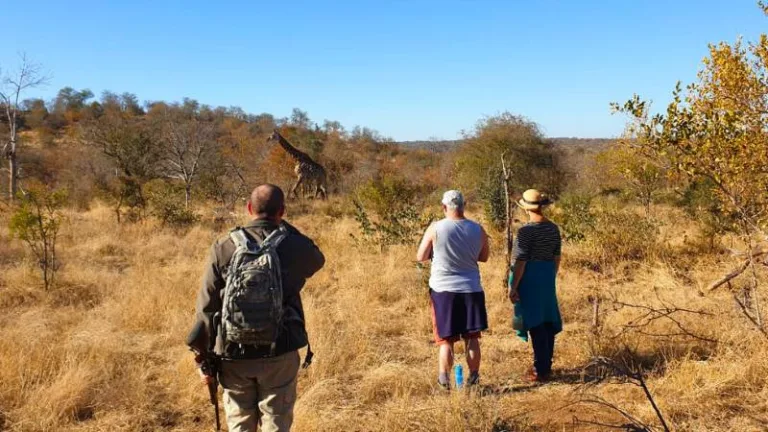
An elephant encountered on foot is something else entirely. Especially when you’re watching it watching you!
You become more aware of wind direction, body language, distance, cover and the guides’ instructions. Every sense sharpens.
This is what makes the Primitive Trail so different from a normal safari.
You are no longer watching the bush from the outside.
You are in it.
Different Trail Options available at Hluhluwe-Imfolozi
xxx
Current Costs for Hluhluwe-Imfolozi Trails
Based on the number of options available it is best to contact Ezemvelo and obtain up-to-date pricing.
Please note that park entry fees, guide tips and other incidentals are not included.
How To Book
Call: +27 (0)33 845 1000 or +27 (0)33 845 1067
Email: trails@kznwildlife.com or mftrails@kznwildlife.com
Early booking is essential as spots are limited.
Getting To The Trails
Hluhluwe-iMfolozi Park is in northern KwaZulu-Natal.
For the Primitive Trail, you start at Mpila Camp in the iMfolozi section of the park.
You will need to drive through the park to reach Mpila, so allow enough time for slow roads, wildlife sightings and check-in.
Johannesburg to Mpila
- Johannesburg to the Hluhluwe-iMfolozi area: approximately 555 km and about 6 hr 45 min to 7 hr driving time (exclusing stops).
- Once you reach the Nyalazi Gate, it is another 19 km and roughly 45 minutes to Mpila Camp because of speed limits and game viewing inside the park.
Durban to Mpila
- Durban to Nyalazi Gate: approximately 2½ to 3 hours (around 250–280 km depending on your starting point in Durban).
- Nyalazi Gate to Mpila Camp: approximately 45 minutes because of the park speed limits and the likelihood of stopping for wildlife.
Closest Airport: King Shaka International Airport (Durban)
About Mpila Camp
Mpila Camp serves as the gateway to the Primitive Trail and is where hikers register before heading to Mdindini Trails Camp.
Accommodation options include two-sleeper self-catering chalets, larger family or group units and permanent safari tents.
Facilities are fairly basic. There is no restaurant, so visitors need to be self-catering, although a small shop sells souvenirs and cold drinks and a few snacks.
Most hikers spend only a short time here before setting off on trail, but it provides a comfortable base for arriving the night before or recovering after several days in the wilderness.
Don’t expect luxury. Do expect warthogs wandering through camp and the occasional nyala helping itself to the landscaping.
What To Pack for your Trail
It can be overwhelming to figure out what should stay and what should go when you’re trying to pack for any hike. Take a look our super handy tips on what to pack for your next trail!
How To Pack for a Primitive Trail
When preparing for any backpacking trail, aim to pack as light and compact as possible—every gram counts when you’re carrying everything on your back.
Here are some expert pointers on how to pack your backpack if you’re feeling slightly uncertain about what should go where.
Don't Forget To...
We understand that hiking in a Big 5 area can be a scary thought. But don’t worry, your guides are well-trained. So…
- Listen to your guides – they ensure safety in big game territory.
- Respect nature – follow the “leave no trace” principle.
- Check weather conditions before your trip.
FAQs
Here are some of the most frequently asked questions about hiking in Big 5 territory.
Wildlife encounters are always possible, but experienced guides are trained to ensure your safety.
No, a minimum group of four is required.
There are, of course, risks associated with all trails. However, if you are with a qualified and experienced guide, then although you can never say that it is categorically not dangerous, the skill, training and experience of your guides will go a long way to mitigating these dangers.
Listen to your guide. Be sensible. And embrace and enjoy the experience!
No, but the guides can access emergency support via their cell phones.
The guides are able to call for assistance if needed.
If you’re going in the depths of winter maybe take a tiny tipple just to warm you up – but you definitely don’t want to be carrying cans and bottles. Remember it’s important to be safe for yourself, the other hikers and the guides.
Ezemvelo closes its backpack trails over the peak rainy season – which is malaria season. However if you are concerned then speak to a local doctor about reasonable precautions.
Top Tips
Bring a treat to share: A bar of chocolate or something like that to share with the group on one of the nights. It’s a nice way to get the group chatting and a nice, sweet treat for everyone.
Don’t forget to tip your guides. Lead guide should usually get around R150 per person per night and back up guide should get about R100 per person per night. Rangers don’t get paid a lot so every bit of appreciation makes a difference.
Final Verdict
Would I do it again?
Absolutely.
In a heartbeat.
The Hluhluwe-iMfolozi Primitive Trail is not perfect.
Your pack may be heavier than expected.
You may collect sandfly bites.
You may find yourself standing night watch beside a fire at two in the morning, listening carefully for leopard, lion or hyena.
You may also end up stumbling through the bush in your sleeping socks and stepping in fresh buffalo dung.
But that is exactly the point.
This is not simply a hike.
It is a wilderness experience.
A chance to walk through one of Africa’s great conservation areas at the pace nature intended.
Long after the sore shoulders and itchy bites have faded, you will remember the sound of a leopard rasping in the darkness across the river.
And if someone offered me a place on the trail again tomorrow, I would be packed before they finished asking.
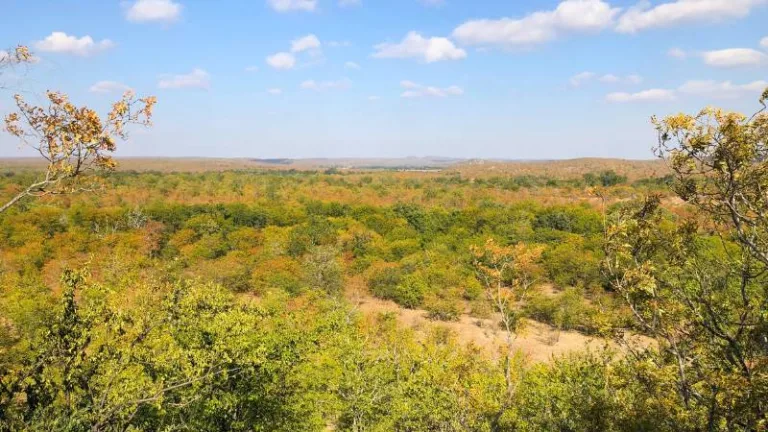
A big thank you to Paul Slyer from PAW Safaris for his images.
If you have an epic hike or trail to share, or if there are any corrections or updates that you would like to suggest to this trail guide, please email