Join Trail Food Ambassador, Francois Jansen Van Vuuren on his journey to The Edge of the World!
An adventure of a lifetime, travelling by foot and awakening in the morning on the back of the Dragon next to one of the tallest waterfalls in the world.
Conquering The Peaks
The morning air was thick with mist, wrapping around the cliffs like a ghostly tide. Each breath was cool and heavy with moisture, the world reduced to shades of grey. The only sounds were the soft patter of water dripping from overhanging rock and the steady rhythm of our boots pressing into the soaked earth. The trail, slick from the night’s rain, gave slightly beneath each step, the mud clinging to our soles as we pushed forward.
The path curved along the mountain’s edge, a narrow contour route hugging the base of a massive peak. It felt like walking through a secret passage carved into the heart of the Drakensberg, where each step forward revealed only fragments of the world beyond. Then, just as the mist shifted, I caught my first real glimpse—what I call the Witch’s Windows.
Through the swirling veil of white, a towering giant emerged—the Dragon’s Tooth. A jagged monolith standing defiant against the sky, its dark silhouette framed by the ever-moving mist. The Amphitheatre beyond remained hidden, but this—this was a moment to pause. To take in the sheer scale of the landscape, to feel the raw power of the mountains pressing in on all sides.
And this was just the beginning. The trail ahead would take me higher, deeper into the heart of one of the most breathtaking places on earth. But for now, standing on the edge of the unknown, I let the moment sink in.


The Amazing Landscape: Beacon Buttress
This section of the trail has always felt like something out of a dream—wild, vast, and utterly breathtaking. As we made our way along the path, the landscape opened up in a way that few places ever do. Beacon Buttress stood before us in a near- perfect 360-degree view, its rugged cliffs commanding attention. Looking back, the Sentinel Car Park seemed impossibly distant, a tiny mark against the endless backdrop of mountains and sky. There’s something special about this moment—the feeling of standing on the edge of the world, surrounded by peaks that have stood for centuries, untouched by time.
To our left, the Gully cut deep into the mountainside—a steep, narrow passage disappearing into the mist. Even from a distance, it felt mysterious, like a gateway to something hidden. Thick mist poured down, swirling through cracks and crevices, cloaking the jagged rocks in shifting shadows. The silence here was heavier, as if the mountain itself was holding its breath.
And then, the final stretch. The moment you know what’s coming. My breathing turned heavy, my forehead damp with cold sweat. My hands were clammy, gripping my pack straps almost instinctively. There was no turning back now. The famous chain ladders waited ahead.
I tilted my head up, staring at the 40-meter steel ladders, disappearing into the mist, their ends swallowed by the low-hanging clouds. Cold drops ran down the rusted chains, glistening like tiny beads of ice. And then—contact. The first touch of ice-cold steel against my fingertips sent a shiver through me, not just from the cold, but from the reality of what lay ahead.
It was time to face my fear.


THE ROAR OF ELANDS FALLS
Climbing the ladders was a humbling experience—each step a test of trust in nothing but my own grip. Suspended between earth and sky, I felt powerless, the cold steel beneath my fingers the only thing anchoring me to the mountain. With every upward pull, the world below faded, swallowed by the mist. It wasn’t just my journey up the ladders; it was ours. A father and son, moving as one, step by step, rung by rung. The only thing louder than the wind was the encouragement we gave each other. A reassuring word, a steadying hand, a glance that said, we’ve got this. Climbing those ladders alone is daunting—doing it together made it an unspoken bond, strengthened with every careful movement upward.
Then, as we pressed through the thick veil of cloud, a sound emerged in the distance. At first, it was just a low rumble, muffled by the mist. But with each step forward, it grew—a deep, thunderous roar carried by the wind. It wasn’t just sound; it was power, movement, force.
Reaching the plateau, we stood still, straining to see through the shifting mist. Then, as if the mountain chose to reveal its secret, the clouds parted for a moment. There it was—Elands Falls, a torrent of water carving down the rock face, crashing into the valley below with relentless energy. The mist swirled around it, briefly hiding and revealing the falls as if nature itself was painting and erasing the scene before us.


Up close to the mighty Dragon
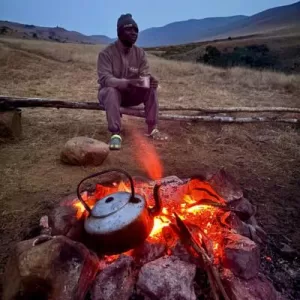
After leaving Elands Falls and the chain ladders behind, we began our hike along the Tugela River. The path unfolded before us, offering the first glimpse of the mighty Devil’s Tooth in the distance. It was here, too, that we witnessed the shepherds in their element, guiding their flocks of sheep and herds of cows across the rugged landscape. As we set up camp, we were greeted by curious cows, drawn in by the bright colours of our tents. Two of them even managed to pull out some of our tent pegs, much to our amusement.
Just as we finished setting up camp, the scheduled rain arrived. It was a soft drizzle, but just enough to slow us down and give us a chance to relax and sip on some coffee. The rain eased off, and soon we were back on our feet, heading toward Tugela Falls. As we drew closer, the sound of the water grew louder, a deep rumble from the falls cascading over the cliffs and crashing against the mountainside. It was a moment of awe, standing there as the force of nature surged around us. We explored the area briefly before returning to camp, knowing more rain was on the way.
Back in our tents, the soft rain began again, and we settled in to prepare our dinner. The sound of the rain was soothing, and our conversations echoed through the tents as we enjoyed a peaceful evening together. A brief break in the weather gave us time to stretch our legs and say our goodnights, the cool breeze from Crow’s Nest and Mont Aux Sources sending a chill through the air. Luckily we were prepared, and with the upgrades I’d made to my gear, I slept like a baby, feeling cozy and content despite the storm outside.


THE WALL OF THE NORTH
The Amphitheatre in the Northern Drakensberg is a sight that words and pictures scarcely capture. Standing before its towering basalt cliffs, one truly grasps the scale and grandeur of this natural marvel. This immense rock wall stretches approximately 5 kilometres from the Eastern Buttress to the opposite end, forming a natural barrier that has both protected and defined the region.
At the heart of the Amphitheatre lies Tugela Falls, one of the world’s longest waterfalls, plunging 983 meters in a series of breathtaking drops. Hidden nearby is the lesser-known Ribbon Falls, a serene cascade that offers a tranquil contrast to the mighty Tugela. The top of the Amphitheatre provides a relatively flat expanse, making it accessible for hikers and offering panoramic views that are nothing short of mesmerising.
Beneath this lies Royal Natal National Park, a haven for biodiversity and outdoor enthusiasts. The park features the famous Tugela Gorge Hike leading hikers to a stunning view of the Amphitheatre’s base. This area is also home to unique rock formations, including the well-known Policeman’s Helmet.
The Drakensberg, or Mountains of the Dragon, holds rich history and culture. Once home to the San people, its caves are adorned with ancient rock paintings. Today, the Amphitheatre stands as a testament to this heritage, inviting visitors to witness its beauty first hand.


Find out more about 'hiking with francois'
Instagram: https://www.instagram.com/hiking_with_francois/
Facebook: https://www.facebook.com/Hikingwithfrancois
WhatsApp: +27 83 226-9374
Email: hikingwithfrancois@gmail.com
A big thanks to Francois for the article and stunning photographs.